Everyone kills it, even Kurupt (who I can't fucking stand). Pac and Meth bring it the hardest, particularly Meth and his edited "Hitler, stickin' up Jews with German Rugers" line. Minimalist beat that lets all five emcees rip the mic. Perfect song, IMO.
- Pre-season All-America Team - Pre-Season All SEC Team - Heisman Trophy Predictions - Top 10 Players in the Nation - Conference Winners - 5 Teams With a Dark Horse Shot to Make the National Title Game
First, My Pre-Season All-America Team:
QB: Tim Tebow, Florida RB: Jahvid Best, California RB: Kendall Hunter, Oklahoma State WR: Dez Bryant, Oklahoma State WR: Dezmon Briscoe, Kansas TE: Dennis Pitta, BYU OL: Russell Okung, Oklahoma State OL: Brandon Carter, Texas Tech OL: Rodney Hudson, Florida State OL: Ciron Black, LSU OL: Sam Young, Notre Dame
DE: Jerry Hughes, TCU DT: Terrance Cody, Alabama DT: Gerald McCoy, Oklahoma DE: Jammie Kirlew, Indiana LB: Brandon Spikes, Florida LB: Travis Lewis, Oklahoma LB: Sean Weatherspoon, Missouri DB: Tervard Lindley, Kentucky DB: Morgan Burnett, Georgia Tech DB: Eric Berry, Tennessee DB: Taylor Mays, Southern California
A good mix of players here. The Big 12 has the most players from a particular conference, though the SEC has a lot of representatives as well; Tebow, Spikes, and Berry were sure things, though you could make an argument for a guy like Kristofer O'Dowd making the First Team over Ciron Black. The Big 12 is stacked with talent, and has a number of guys who could make the first team. Tight end Jermaine Gresham may have the best argument, but I'd put Pitta (barely) over him for now. I would have placed South Florida's George Selvie at DE, but Kirlew's stats (74 tackles, 21 for loss, 10.5 sacks) were too good to ignore. Overall, though, no big surprises here. Now, let's move on the the All-SEC Team.
QB: Tim Tebow, Florida RB: Michael Smith, Arkansas RB: Charles Scott, LSU WR: AJ Green, Georgia WR: Julio Jones, Alabama TE: DJ Williams, Arkansas OL: Josh McNeil, Tennessee OL: Mike Johnson, Alabama OL: John Jerry, Mississippi OL: Ciron Black, LSU OL: Maurkice Pouncey, Florida
DE: Carlos Dunlap, Florida DT: Terrance Cody, Alabama DT: Geno Atkins, Georgia DE: Greg Hardy, Mississippi LB: Brandon Spikes, Florida LB: Rennie Curran, Georgia LB: Eric Norwood, South Carolina DB: Eric Berry, Tennessee DB: Trevard Lindley, Kentucky DB: Janoris Jenkins, Florida DB: Ahmad Black, Florida
Florida gets lots of love here, but none of it undeserved. Spikes and Tebow speak for themselves, but the others played damn well last year, too. Dunlap led the SEC in sacks, Black tied for the national lead in interceptions, Pouncey has been an anchor for Florida's offensive line, and Jenkins has already shown himself to be one of the best young cover corners in the country. Outside of them are a lot of usual suspects. Eric Norwood may be one of the country's most underrated linebackers, and young receivers AJ Green and Julio Jones aim to build on strong freshmen years. Tennessee has two sure fire first round NFL draft picks in Berry and McNeil, which makes last year's on-field performance all the more egregious. Finally, Arkansas' Williams and Smith are reasons 1 and 2 as to why the Razorback offense will be potent this year, even with the loss of Jonathan Luigs.
Next, let's move on to the conference winners.
Big 12: Oklahoma The Big 12 South looks to be a tough road to hoe again, with Oklahoma, Texas, and Oklahoma State all jockeying for top position. With the losses of Michael Crabtree and Graham Harrell, Texas Tech should take a step back from an 11-2 year, while Oklahoma State, which returns nearly every key starter from last year's 10 win season, should take Tech's spot in the fray. The Cowboys bring in defensive coordinator Bill Young, who made Kansas' defense fierce two years ago and did good things at Miami last year. He will be the key to whether or not OKSU makes the leap from good to great this year. Their offense--led by Zac Robinson, Kendall Hunter, and the ever-dangerous Dez Bryant--should be fine again, but it's been failures on defense that have hurt the Cowboys the past few years. If they can shore up that side of the ball, Oklahoma State could make a BCS bowl game this year. However, I'm not sold on them making such a leap this year; Texas and Oklahoma still own the division, and the conference as a whole. Oklahoma loses Phil Loadholt and Duke Robinson, but returns Sam Bradford, Jermaine Gresham, and a defense that looks to leap towards dominance this year. With DeMarcus Grainger and Gerald McCoy on the defensive line, there's no reason why they shouldn't. Texas brings back Colt McCoy, and the running backs--a weak spot for the Longhorns last year--will be a year older. Add to that additional experience for a defense that hit its groove near the end of last year, and Texas should be better this year. Kansas could make some noise in the conference and looks like the runaway winner to take the Big 12 North, but I'm not sure if they can challenge Oklahoma or Texas right now. Like most years, the winner of the Red River Shootout should win the conference, and with the Sooners defense being led by Grainger and McCoy (and with no big time playmaker on Texas' defense like Brian Orakpo), I have to give them the edge right now.
Big Ten: Ohio State This conference seems pretty easy to predict right now. Michigan's still down, Michigan State has another year or two before making any real noise, Iowa lost its best offensive player to the NFL draft, and Wisconsin just isn't a very good team. For me, then, this leaves three possible contenders for the Big Ten crown: Illinois, Penn State, and Ohio State. Illinois should have a strong offense led by Juice Williams (who would've won the award for "Nation's Most Underrated Player" had he not won the award for "Player Who Picks the Worst Times to Screw Up in Games"), Arrelious Benn (who picked up Juice's former award last year), and Daniel Dufrene. However, their lack of defense probably makes them third or fourth in the conference. Penn State returns Daryl Clark and the strong running tandem of Evan Royster and Stefphon Green, as well as the majority of a usually-strong defensive unit; however, they lose two playmakers in Derrick Williams and Deon Butler. Ohio State has issues as well--most notably the losses of Chris Wells, James Laurinaitis, and Malcolm Jenkins--but returns a solid RB tandem of Brandon Saine and Boom Herron, a good offensive line, and, most importantly, Terrelle Pryor. Pryor showed flashes of greatness last year, and should only get better this year. They lose two receivers in Brian Hartline and Brian Robiskie, but those losses could be assuaged if guys like Dane Sanzenbacher, Ray Small, and Lamarr Thomas step up. On defense, they lose Donald Washington, Malcolm Jenkins, and Laurinaitis, but these loses should be dampened by the fact that other teams in conference lose key players as well. With Penn State losing its best playmakers, it becomes harder for them to exploit OSU's losses. Overall, all of the major teams in the Big Ten lose a great deal, but Tressel's coaching prowess should see the Buckeyes through to another conference crown.
SEC: Florida The SEC is generally recognized as one of the best conferences in the country, but last year left a lot to be desired. Georgia, a preseason #1 coming into the year, faltered with losses to Florida, Alabama, and Georgia Tech, settling for a Capital One Bowl appearance. Meanwhile, defending champion LSU stumbled to a five loss year. Alabama did rise up to a 12 win season, but suffered a disappointing loss to Utah in the Sugar Bowl. This year, the SEC seems poised to fare better, with Ole Miss, Alabama, and LSU all looking to be stronger than they were last year. However, Florida, returning every player on defense and seven more on offense, is the prohibitive favorite to win the national title this year. They return Tim Tebow, three of five starters on the offensive line, and a dangerous rushing attack led by Chris Rainey and Jeffrey Demps. The only question mark for the Gators? Wide receiver, given the losses of Percy Harvin and Louis Murphy. However, with the players that the Gators have in waiting, a few are bound to step in and be productive this year. Alabama stands as the toughest challenge for the Gators this year, and the two could meet up again in the conference championship. However, Tebow and Brandon Spikes have shown that they can inspire the Gators to new heights when need be, and I don't see any reason that this wouldn't continue through next year.
ACC: Georgia Tech The ACC is a jumble and hard to predict. You can eliminate some teams (Duke, NC State, Maryland), but the rest is a coin flip. Wake Forest probably takes a step back after losing Alphonso Smith, but I can see the other eight teams making a run at the title. Virginia Tech, Georgia Tech, and North Carolina are the teams that I think have the best chances of winning the conferences, but Florida State, Clemson, and Miami are viable options, too. The latter three are stacked with talent, and could put it together for good runs in a mediocre conference. However, FSU suffers from bad coaching, Miami will be adjusting to a new OC and DC, and Clemson seems to have mid-to-late season collpases like clockwork. That leaves UNC, VT, and GT, and of these, I think the Yellow Jackets have the best chance of taking the conference. They return almost all of their offense, including quarterback Josh Nesbitt and star runningback Jonathan Dwyer, as well as their offensive line. They lose players on defense, most notably defensive end Michael Johnson, but they do keep their best playmaker in Morgan Burnett. Plus, they have an excellent coach in Paul Johnson who coached Tech to a 9-win season last year. They get Miami and Florida State on the road, but do get UNC, GT, and Wake at home this year. In what I see as a three team race this year, I think GT can and will come out on top.
Big East: South Florida The Big East, like the ACC, is a difficult conference to predict. West Virginia, South Florida, and Cincinnati could all win the conference next year. Brian Kelly's shown that he can be a great coach for the Bearcats, and coached them to the Orange Bowl last year, and they do return quarterback Tony Pike and runningbacks John Goebel and Jacob Ramsey. However, they lose their two leading receivers, Dominick Goodman and Marshawn Gilyard; they also lose their two biggest defensive playmakers in Mike Mickens and DeAngelo Smith. West Virginia loses Pat White, but returns the very capable Jarrett Brown, Noel Devine, and a receiving corp that showed themselves to be more than able during their bowl game against North Carolina; however, they lose a number of starters on defense, and are still in rebuilding mode on their offensive line. Given this, I think South Florida is finally poised to take the conference this year; after two years of disappointment, the Bulls may have all the tools in place to make a run. On offense, their only significant loss is receiver Taurus Johnson; they return quarterback Matt Grothe, and a four-pronged rushing attack headed by Grothe as well as Mike Ford, Jamar Taylor, and Moise Plancher. On defense, they lose linebacker Tyrone McKenzie and cornerback Carlton Williams, but bring back pass rusher George Selvie and linebackers Kion Wilson and Jerome Murphy. If Selvie can bounce back to his sophomore year form, he'll not only create problems for opposing teams, but help out his defensive linemen as well. With Jim Leavitt as coach, I don't see Selvie having another down year.
Pac-10: Southern California If there's any year another team can rise up from the Pac-10, it has to be this year. USC loses Mark Sanchez, Patrick Turner, it's three starting linebackers, defensive lineman Fili Moala, and defensive back Cary Harris. However, I can only see Oregon and possibly Oregon State challenging the Trojans this year. I'm not sold on Cal, even though they have a legit Heisman candidate in Jahvid Best; until they produce something--anything--in the way of a decent quarterback, Best is going to be a one man offense again. Washington and UCLA are years away from being decent, and Arizona State just isn't very good. Oregon State returns quarterback Lyle Moevao and runningback Jacquizz Rodgers, but loses its two leading receivers and best defensive player. Oregon may be the best threat to USC's reign in the Pac, as they return the core of a very strong offense led by Jeremiah Masoli and LaGarrette Blount, but they also lose the heart of their defense in Patrick Chung. Plus, Offensive coordinator Chip Kelly takes over for former head coach Mike Belotti, and while that may not be a huge deal, it's bound to cause some degree of instability within the organization. Meanwhile, USC continues to be a well-oiled machine, headed by Pete Carroll. They've shown the ability to play at a high level despite losing some of their best players, and I see no reason why that trend shouldn't continue given the talent at USC's disposal.
Now, on to this year's dark horse teams to make the National Title Game:
1. The Oklahoma State Cowboys: Why: The Cowboys return the core of their offense in Zac Robinson, Kendall Hunter, and Dez Bryant. They lose an excellent tight end in Brandon Pettigrew, but the running game should do a lot to fill the gap left by his absence. On defense, Bill Young is the new coordinator, and he should be able to improve a Cowboys defense that's been much maligned the past few years. In terms of scheduling, they open with a reasonably tough game against Georgia, but they get the Bulldogs at home. In conference, they get Texas at home, as well as Missouri and Texas Tech. Oklahoma State gets Oklahoma on the road, but if they can manage to pull an upset against the Sooners, they could find themselves in NC game contention. Why Not: Oklahoma and Texas stand in their way. The two have ruled the Big 12 this decade, particularly Oklahoma, and Oklahoma returns the cores of both their offensive and defensive squads. Texas still has Colt McCoy along with a maturing defense. Those two games will be the toughest on the Cowboys' schedule by far; add to that the fact that OKSU has to travel to Norman at the end of the year for the Bedlam game, and they could derail Okie State's title hopes. Prediction: 10-2, with losses to Oklahoma and Texas
2. The Oregon Ducks: Why: Much like the Cowboys, Oregon has an excellent offense, particularly in the rushing game. With Masoli and Blount leading the charge, the Ducks are bound to roll up yards and points on opponents. Chip Kelly takes the reigns as head coach, but the team shouldn't suffer for it at this point. The passing game should also be improved over last year; Masoli only completed 57% of his passes last year, so he should improve on those numbers this year. They do lose Jaison Williams and Terrence Scott, but tight end Ed Dickson may be one of the most underrated players at his position, and Jeffrey Maehl should be ready to step up as a leading receiver; also look at for USC transfer Jamere Holland, who could be finally ready to fulfill his potential. If they can avoid an opening season loss to Boise State, and manage an upset against the Trojans, Oregon could be an end of the year contender for a title game. Why Not: Defense. The Ducks had a porous defense last year, despite having NFL draftees in Jairus Byrd and Patrick Chung. With those two gone, it's hard to imagine the Ducks being any better in that regard. Plus, they've got some difficult games on their schedule, including an opening game road trip to Boise State, who beat them in Autzen Stadium last year. They get their most difficult games--USC, Oregon State, and California--at home, but home field advantage may not be enough to help Oregon, particularly against the talent-laden Trojans and the Jacquizz Rodgers-led Beavers. Prediction: 10-2, with losses to USC and Oregon State
3. The Ole Miss Rebels: Why: They've got a good coach, a good quarterback, and a great playmaker. Houston Nutt did a great job of coaching the Rebels last year, helping them to wins over Florida and Texas Tech. Jevan Snead stepped up his play throughout the year, as well; over the last seven games of the year, he threw 17 touchdowns and only four interceptions. He should only build on that high level of play with another year of experience under his belt. Plus, Ole Miss sports a great rushing attack led by Cordera Eason, Brandon Bolden, and the fantastic Dexter McCluster. McCluster might be one of the best all-around players in the country, and he showcased his talents by torching Texas Tech to the tune of 83 yards receiving and 97 more on the ground. Their offense shouldn't lack for anything this year. Add in Shay Hodge at receiver, and they could have one of the most complete offenses in the country. On defense, they lose Peria Jerry, but return pass rushing specialist Greg Hardy and leading tackler Kendrick Lewis. In terms of scheduling, they have an easy out of conference schedule, and get Alabama, Arkansas, Tennessee, and LSU all at home. If they can take Bama at home, and beat LSU for the second straight year, I think they'd have to be in contention for making the title game (assuming they have only one loss at the end of the year). Why Not: They have to compete with Florida and Alabama in the SEC. You could also make a strong case for LSU, given the talent they bring in this year. However, Florida and Bama have to be the two big dogs. They play Bama in the regular season, with with the Crimson Tide returning nearly all of its defense, I don't think the Rebels will be able to manage much, even if they are at home. If they do manage to win the West, they'll have to contend with a Florida team that, like Alabama, returns nearly everyone from last year's squad. Add to that the motivation of avenging a humiliating home loss to the Rebels, and Ole Miss could end up suffering a late season heartbreaker. Prediction: 9-3, with losses to Alabama, LSU, and Arkansas
4. The Virginia Tech Hokies: Why: Frank Beamer always seems to have his team prepared. They lost Vince Hall, Xavier Adibi, Chris Ellis, and Branden Ore, and still managed to finish 10-4 last year, including an Orange Bowl win over Cincinnati. They found two playmakers on offense in Darren Evans and quarterback Tyrod Taylor, who showed flashes of his full potential last year; he had three 100 yard rush games last year, including 137 against Virginia. If he can continue to develop as a passer, then the Hokies should be a dangerous team. They get Alabama to begin the year, so they could still be in the NC game picture even with a loss. Additionally, they get Miami, North Carolina, and Boston College at home, leaving Georgia Tech as the only real threat they play on the road. If they can manage to run the table in the ACC (assuming a Bama loss), or get by with one loss (assuming they beat the Tide), VT could be in national title talks. Why Not: I'm still not sold on Tyrod Taylor as the quarterback. I love him as a talent, but even late in the year, he didn't seem like he was becoming a fluid passer. He had 140 yards passing on 22 attempts in the Orange Bowl, and 84 yards passing on 19 attempts the game before that. I know spring practices can do a lot to help players develop, but I can't help but think of how well he's going to fare with defenses like Miami's, BC's, or Bama's coming at him full speed. His feet can only do so much to help him. If VT's going to make the next step, it's going to be dependent on whether or not Tyrod Taylor can become a more complete QB; at this point, I don't think he will. Prediction: 9-3, with losses to Alabama, Georgia Tech, and North Carolina
5. The West Virginia Mountaineers: Why: They've got Jarrett Brown, Noel Devine, and a solid receiving corps on offense, and a defense that should be improved over last year's. Losing Pat White is a big hit, but Brown has shown the ability to step in and play well in White's absence in the past. Now, with the starting role his, Brown can utlize his skillset to the fullest. He's a better passer than White, and mobile as well. This means that coach Bill Stewart can retain his current offensive strategy, as it suits Brown's skills. Noel Devine should also improve his numbersfrom last year, as he ran for almost 1300 yards on over 6 yards a carry. Also, the Mountaineer receivers aren't to be overlooked; Jock Sanders and Arlic Arnett proved themselves to be solid last year, and should only be better this year. Plus, the 6'8" Wes Lyons is healthy and looks to make a splash this year. On defense, they return most of their players, and while they didn't look great against North Carolina during their bowl game, a year's worth of experience could go far to help out. Schedule-wise, they get Pittsburgh and Connecticut at home, leaving South Florida and an early date against Auburn as theit toughest road opponents. If they can get past those two, and get through the Big East undefeated, they could be in the NC game. Why Not: I don't think Bill Stewart is that good of a coach. I thought his attempt at turning Pat White into a passer ultimately killed WVU's chances at being an elite team last year; there were too many times where I saw White looking downfield when he would've normally tucked the ball and run for yards. Stewart made White hesitant, and their offense sputtered because of it. This isn't to say that he's going to do something similar to Brown this year, but I think his handling of White definitely raises questions about his ability to get the most out of his players. In terms of more tangible aspects of the team, West Virginia gets USF and Cincinnati on the road this year; USF has beaten WVU two out of the past three years, and could field its strongest team in years. The Bearcats haven't fared nearly as well, but a late-season roadtrip to Cincy could prove to be a trap game for the Mountaineers. Most importantly, though, I don't think a one loss WVU team makes the NC game over a one loss team from another conference; the Big East is seen as weak, and will not get the same respect as a team from a conference like the Big 12 or SEC. WVU has to go undefeated to have a shot at making the big dance, and I don't think they have the team to do that. Prediction:10-2, with losses to South Florida and Cincinnati
And now, the top 5 Heisman Candidates:
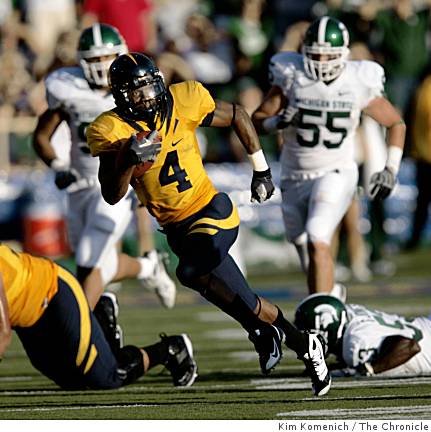
5. Jahvid Best, California Best may be a reach in terms of finishing position, but for right now, I think he's right where he needs to be. I don't see Cal being as good as OSU, Texas, Oklahoma, or Florida, so that hurts his stock here. However, his play is too good to ignore. Last year, he rushed for 1580 yards on over 8 yards per carry; he also added 15 touchdowns. He showed a flare for putting up big numbers, as well, running for 194 yards in the Las Vegas Bowl against Miami, 201 against Stanford, and 312 yards against Washington. However, to be a serious contender for the Heisman, Best has to perform in big games. In Cal's biggest game of the year (USC), Best rushed for a mere 30 yards on 13 carries. That isn't the type of performance that gets you recognized as the nation's most pretstigious player. However, with quarterback Kevin Riley being a year more experienced, he could take some pressure off of Best, allowing him to perform better when need be.
4. Zac Robinson, Oklahoma State Personally, I'd replace Robinson with Kendall Hunter, but given the insane amount of attention given to quarterbacks, expect to see Robinson get the Heisman love. This isn't to say that he's a chump, though; in fact, he put up damn good numbers last year. He completed 65% of his passes, threw for over 3000 yards, and added another 564 on the ground. He also showed the ability to perform well in important games; he threw for 254 yards and ran for another 90 against Oklahoma, and threw for 329 yards against Oregon. The problem? Oklahoma State lost both of those games. For Robinson to be a contender, the Cowboys have to win their big games this year. With Texas and Oklahoma looming on the schedule, Robinson will have two chances to make statements to the Heisman voters across the country. If he can, expect to see him in New York as a top Heisman candidate.
3. Colt McCoy, Texas As last year's Heisman runner-up, Colt McCoy did a little of everything for Texas. In addition to being the Longhorns' leading passer, he also led the team in rushing, putting up 561 yards on thr ground last year. He also threw for almost 4000 yards, while completing an outstanding 77% of his passes. Against Oklahoma, he passed for 277 yards, and in a comeback win against Ohio State, he threw for 414 more, including a game winning touchdown pass to receiver Quan Cosby. What kept him from winning the Heisman? Texas' loss to Texas Tech, and Sam Bradford putting up insane passing numbers. The UT loss pushed them on the back burner in favor of the Sooners, effectively taking the spotlight from McCoy enough for Bradford to take the trophy. For McCoy to win it this year, Texas--and by extension, Colt McCoy-- may have to have a year similar to last year's, save avoiding a horrendous three-way tie breaker scenario.
2. Tim Tebow, Florida Tebow finished third in the Heisman race last year, with a harrowing loss to Ole Miss inspiring him to step up his play. In the games after that loss, Tebow threw 24 touchdown passes against just four interceptions, and Florida eventually won the national title. He played well in Florida's big games, scoring five touchdowns against rival Georgia, leading a comeback in the SEC championship game against Alabama, and ending the season with a 340-yard effort in the national title game against Oklahoma. Playing for the defending national champions automatically lifts his Heisman stock, and his being a quarterback only helps out in this regard. For him to repeat as a Heisman winner, though, Tebow may have to put up more gaudy stats. He passed for 2746 yards last year, which is good, but a far cry from the 3896 he put up his sophomore year. With Percy Harvin gone, we might see Tebow revert back to his 2007 form to some degree.
1. Sam Bradford, Oklahoma He passed for 4720 yards, 50 touchdowns, and just eight interceptions last year; he also quarterbacked the highest scoring team in NCAA history. He won the Heisman last year, becoming just the second underclassman to do so. Given this, is there any doubt that he's the leading candidate coming into this year? Oklahoma lost two offensive lineman and three receivers, but talent isn't exactly a weak spot for the Sooners. They do face some tough challenges this year (Texas, at Kansas, Oklahoma State), but given Oklahoma's near-stranglehold on the Big 12 this decade, it's not a stretch to assume that they'll be in the Big 12 title picture again. If they can duplicate the season they had last year (which is possible given the return of Jermaine Gresham, Ryan Broyles, and three offensive linemen), expect to see Bradford in position to win the Heisman for a second time.
The Ten Best Players in the Nation:
Honorable Mention: Arrelious Benn (Illinois), Wide Receiver Brandon Spikes (Florida), Linebacker Terrance Cody (Alabama), Defensive Tackle MiQuale Lewis (Ball State), Running Back Todd Reesing (Kansas), Quarterback Dezmon Briscoe (Kansas), Wide Receiver Russell Okung (Oklahoma State), Offensive Lineman Trevard Lindley (Kentucky), Cornerback
And now, the actual list:
10. Dez Bryant (Oklahoma State), Wide Receiver: Bryant emerged as one of the nation's best playmakers last year; were it not for Texas Tech's Michael Crabtree, Bryant may have been the best receiver in the country last year. He's a freakish athlete, able to leap and catch passes with ease with the strength to break tackles in the open field. He's a big play waiting to happen, as evidenced by his 17.01 yards per catch average last year; he also had a number of big games to boot. See his 9 catch, 236 yard performance against Houston. or his 11 catch, 212 yard game against Baylor. Or his 13 catches for 167 yards in the Holiday Bowl against Oregon. With no Crabtree or Jeremy Maclin around, Bryant emerges as the best receiver in the Big 12, and in the country as well. Last Year's Stats: 87 receptions, 1480 yards (17.01 yards per catch), 19 TDs; 17 punt returns, 305 yards (17.94 yards per return), 2 TDs
9. Jammie Kirlew (Indiana), Defensive End: Did anyone remember that Greg Middleton led the country in sacks last year? Evidently, Middleton did, as his performance fell dramatically last year, finishing with just four sacks. In his place Jammie Kirlew stepped up and played excellent ball last year, racking up 10.5 sacks and finishing as the team's second leading tackler. He had 10 tackles and 2.5 sacks against Minnesota, and 11 more tackles against Penn State. If Middleton can get back to his sophomore form, expect Kirlew to put up even better stats this year. Last Year's Stats: 74 tackles (21 for loss), 10.5 sacks, 2 forced fumbles
8. Colt McCoy (Texas), Quarterback: McCoy was Mr. Everything for Texas last year, leading the team in both passing and rushing yards. He finished second in the Heisman voting, and proved himself to be an elite player time and time again. See his clutch performances against Oklahoma and Ohio State for proof of that. What impressed me so much about McCoy last year was his willingness and ability to carry his team; Texas didn't have a running game last year, so Colt did the running. Texas didn't have a great defense last year, so Colt made sure Texas scored enough points to win. He was more than just a good player, he was a leader. If he can lead Texas to a national title game and win it, would he be a better player than Vince Young? We'll have to see. Last Year's Stats: 332-433 (76.67% completion rate), 3859 yards, 34 TDs, 8 INTs; 136 rushes, 561 yards, 11 TDs
7. Jahvid Best (California), Running Back: Best is a beast, pure and simple. You don't run for over 300 yards in a game and not be a damn good player. Best can fly, and his 8.14 yards per carry average shows that. On a team with virtually no passing game to speak of, he carried the offense at times. He's the most dangerous weapon Cal has by far, and is the best offensive player in the Pac-10 for my money (sorry Rod Gronkowski). If Kevin Riley can make strides at QB, expect Best to have an even better year as a junior. Last Year's Stats: 194 rushes, 1580 yards (8.14 yards per carry), 15 TDs; 27 receptions, 246 yards, TD
6. Morgan Burnett (Georgia Tech), Safety: On a defense that saw Michael Johnson get a lot of attention, Morgan Burnett established himself as a dominant playmaker on defense, leading Georgia Tech in interceptions and tackles. Last year, he showed that he has great ball skills while also proving to be a good tackler; this year, with Johnson gone, Burnett's bound to receive the attention of opposing offenses, and they'll attempt to stray away from throwing towards him. However, with his ability to cover ground, Burnett should still make his fair share of plays this year. Last Year's Stats: 93 tackles (9 for loss), 7 INTs, 8 passes defended, forced fumble
5. Kendall Hunter (Oklahoma State), Running Back: If I were a Heisman voter, I'd be wondering why Hunter isn't getting any attention. I'd argue that he--not Zac Robinson or Dez Bryant--is Oklahoma State's best player on offense. Hunter scored 16 TDs last year, and established himself as one of the country's best tailbacks. He is consistent, and can also break big runs; last year, he had carries of 68, 58, 43, 36, and 41 yards. With most of the offense returning this year, there's no reason why Hunter couldn't duplicate, if not improve, last year's production. He comes into this year as the nationa's best running back, and could end the year with that same distinction. Last Year's Stats: 241 rushes, 1555 yards (6.45 yards per carry), 16 TDs; 22 receptions, 198 yards, TD
4. Sam Bradford (Oklahoma), Quarterback: There's not much else that can be said about Sam Bradford; he's a tremendous talent, and he's shown himself to be highly capable of being an elite player on a elite team. He torched defense after defense last year, and helped Oklahoma roll up 734 points in 13 games last year. He puts up video game numbers, and makes it seem easy in the process. The Sooners look to make it back to the national title game, and with Bradford leading the way (along with reliable target Jermaine Gresham), they have as good a chance as any team in the nation. Last Year's Stats: 328-483 (67.71% completion rate), 4720 yards, 50 TDs, 8 INTs
3. Gerald McCoy (Oklahoma), Defensive Tackle: Space-eater, indeed. Gerald McCoy is the best player at his position in my mind (sorry, Terrance Cody), and he can flat out play. Oklahoma finished the year 20th in rushing defense, and McCoy was the biggest reason why. He was second on the team in sacks, third in tackles for loss, and even threw in an interception during the national title game against Florida. Given his size and strength, there's little doubt as to why he could be an early first round pick at the end of next year. Last Year's Stats: 30 tackles (14 for loss), 6.5 sacks, 2 forced fumbles, 2 QB hurries, INT
2. Tim Tebow (Florida), Quarterback: Like Bradford, there isn't much else to add about Tim Tebow. He's won a Heisman, two national titles, and was named the MOP for the second one. He--along with Brandon Spikes-- is the heart and soul of the Florida Gators, and stepped up his level of play dramatically following the Gators' home loss to Ole Miss. During the SEC Championship game and the National title game, Tebow was a man on a mission, leading the Gators to a comeback win in the former game and turning in a gutty second half performance in the latter. This year, with a team loaded with starters from last year's squad, Florida looks to repeat as national champions. With Tebow at the helm, they could very well do so. Last Year's Stats: 192-298 (64.43% completion rate), 2746 yards, 30 TDs, 4 INTs; 176 rushes, 673 yards, 12 TDs
1. Eric Berry (Tennessee), Safety: I bet Berry wishes he played for another team. Maybe not, but if he did, he'd have undoubtedly won the Thorpe Award last year. Eric Berry is as big of a defensive playmaker as you can find; check out his 265 return yards on just 7 picks last year for proof. He led the nation in interceptions, and finished second on his team in sacks, third in tackles, and third in tackles for loss. He was the biggest reason why Tennessee fielded a stout defense last year, and should only get better with another year of experience. Berry has a rare combo of ball skills and physicality, as he can lay a hard hit or leap for the interception. Mel Kiper compared him to Ed Reed, and while I think Kiper's a talking piece of hair, I don't think he's far off in that comparison. Berry is a hell of a talent, and I'd take him over any defensive player in the nation right now. Last Year's Stats: 72 tackles (9 for loss), 7 INTs, 6 passes defended, 3 sacks
Never went as hard as he did on "WWIII." Did an album that went brick despite a pretty good single. Of course, Jada and Scarface outdo him on the track, but Yung Wun holds his own well here.